My Failed Hustles: 4 Ideas That Lost Money and the Lessons in the Ledger
Four side businesses that lost money, rebuilt line by line at 2026 prices: storage-unit auctions, firewood by the cord, an antique-mall booth, and a surplus-auction mower. What each one cost, the exact assumption that broke, and the five-question pre-mortem that would have killed three of them.
Worked examples from researched US prices — educational information, not financial, tax or legal advice. Full disclaimer
On this page7 sections
Everything else on this site is a business that worked, or at least penciled out. This one is the other drawer.
Four ideas that lost money. I've rebuilt each ledger at 2026 prices so the numbers are checkable rather than nostalgic, and I've kept the hours honest, because hours are where the real damage was. Total damage: about $1,600 and 136 hours, which works out to paying roughly $12 an hour for an education I could have gotten for free by reading the terms of sale.
Failure is also the ordinary case, not a character defect. Federal data on new private-sector establishments shows roughly half still open at the five-year mark and about a third at ten. The useful question was never whether an idea might fail. It's which specific number is going to do it.
Failure one: the storage unit that was mostly boxes
The pitch is irresistible. A facility auctions off a delinquent tenant's unit, you bid from the doorway without touching anything, and winning bids run from under $100 to nearly $1,000. You've seen the show.
I bid $325 on a unit with a decent dresser visible and a lot of cardboard behind it. The dresser was real. The cardboard was clothing, textbooks, and a printer. Two trailer loads went to the transfer station at the going tipping rate, which is the same $60-a-ton math the junk-removal ledger runs on. Over about three months I recovered $410 in sales against $410 in bid, gate fees, and fuel.
Exactly zero dollars, for fourteen hours. The assumption that broke: I bid on volume and assumed value was proportional to it. You are not buying a unit; you are buying an unknown ratio of resale to landfill, and you're buying it with a two-day deadline attached.
Failure two: firewood, or how to lose a year instead of money
This one is the most instructive because the cash loss understates it badly.
Retail firewood looks like a fat margin. Seasoned hardwood runs $275 to $400 a full cord delivered in 2026, with green wood at $150 to $275 and stacking service adding $20 to $80. Log-length loads sell for a fraction of that per cord. Buy long, split it, sell short: the spread is right there.
The spread is real. The calendar is the problem. The EPA's guidance is unambiguous — wood burns best under 20% moisture, and you should season it at least six months, stacked off the ground with only the top covered. Six months is the floor for softer species; dense oak commonly wants a full year or more. Which means wood you buy and split in October is not seasoned-hardwood inventory this winter. It is green wood, and green wood sells at the green price, to customers who will tell you so.
The weight compounds it. A seasoned cord runs roughly 2,000 to 3,000 pounds depending on species; green wood weighs on the order of half again as much, with green red oak cited near 4,900 pounds a cord against about 3,350 dry. A half-ton pickup's payload sticker does not cover a cord of green oak, so every cord is two trips, and every trip is fuel and an hour.
I bought a log-length load around $900, split about seven cords out of it, sold four green at $200, and stacked three to season. Cash out $1,350 against $800 in, with a $1,299 splitter I still own charged in at one season's wear. Sixty hours.
The assumption that broke: I priced firewood as a weekend service business when it is an inventory business with a twelve-month cycle. The three cords left in the yard were worth $825 to $1,200 the following winter — the money wasn't gone, it was parked. But parked capital and a full side yard for a year is a cost, and nobody in the firewood content ever names it.
Failure three: the antique-mall booth
After a good run of Marketplace flipping I decided the listing-and-meeting-strangers part was the bottleneck, and rented a booth so the inventory could sell itself.
Booth rent is public and cheap-looking. One Alabama mall publishes $140 a month for a 10x5 and $165 for a 10x6, deposit equal to one month; nationally, booths run roughly $100 to $600 a month, and most malls take a commission of 10% to 15% on top, plus 3% to 4% for card processing.
Stack those and the break-even is arithmetic, not opinion. Sales have to cover rent after commission, card fees, and what you paid for the goods:
Break-even sales = rent ÷ (1 − commission − card fee − cost-of-goods %)
At $165 rent, 10% commission, 3% cards, and 36% cost of goods, that's $165 ÷ 0.51 = $324 a month just to hold even. I averaged about $242. Six months of that is a $251 hole, and the resale trade's rule of thumb is that you want to clear three times rent to survive and five or six to actually earn — I never cleared one.
The assumption that broke: I traded a variable cost for a fixed one and called it leverage. Marketplace flipping charges you nothing when you sell nothing. A booth charges you $165 in February whether anyone walks in or not, and February is when nobody walks in.
Failure four: the surplus mower that was retired for a reason
Government surplus is genuinely a real channel — municipalities dump serviceable equipment cheap, and the same used-equipment inspection discipline applies exactly as written. What I skipped was the "inspection" half.
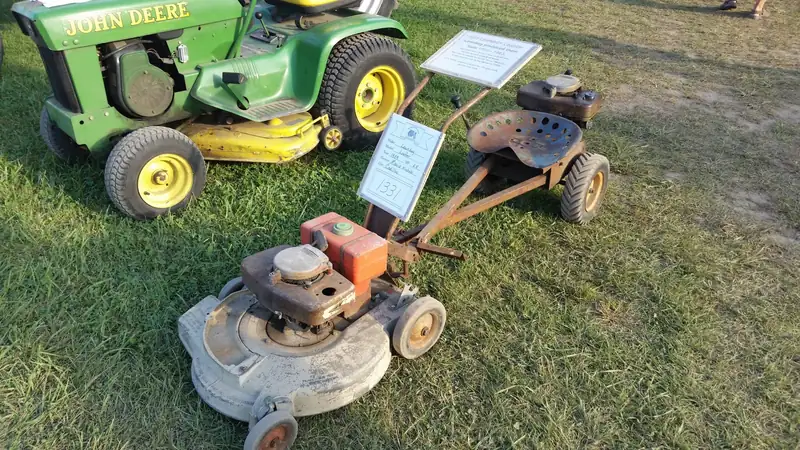
Surplus platform terms are strict and public. Expect a buyer's premium in the 7.5% to 12.5% range on top of your bid, payment due within about five business days, removal within roughly five to ten, and everything sold as-is with no buyer-protection program — your recourse is a conversation with the selling agency. I bid $1,150 sight-unseen on a commercial mower, paid $115 in premium, drove 90 miles each way with a rented trailer, and discovered a hydrostatic drive that a city shop had already decided wasn't worth fixing. Because it wasn't.
$600 in parts, $95 for a diagnosis, and a $1,300 sale three months later. Down $800, plus 22 hours.
The assumption that broke: I treated a photo as an inspection. In an as-is market, the seller's information advantage is the price. Municipal equipment gets surplused when the shop stops wanting it, and the listing is not obligated to explain why.
| Venture | Money in | Money out | Hours | Net |
|---|---|---|---|---|
| Storage-unit auction (one unit) | $410 | $410 | 14 | $0 |
| Firewood, one log load | $800 | $1,350 | 60 | −$550 |
| Antique-mall booth, 6 months | $1,450 | $1,701 | 40 | −$251 |
| Surplus-auction mower | $1,300 | $2,100 | 22 | −$800 |
| Total tuition | $3,960 | $5,561 | 136 | −$1,601 |
Reconstructed from my own records and re-priced against 2026 market data — auction premiums, firewood and booth rates, and tipping fees as cited above — so the figures are illustrative of the structure rather than exact historical receipts. The firewood line excludes three unsold cords worth $825–$1,200 the following season; counting them, that venture was roughly break-even and simply slow.
The four shapes, and they repeat
Line the failures up and they aren't four mistakes. They're two axes.
As-is markets charge you for certainty you didn't buy. The mower and the storage unit are the same failure with different props: I paid a confident price for information I did not have. In those markets the discount is the risk premium, and skipping inspection means paying full price for it twice.
Time is a cost with no line item. Firewood didn't lose money so much as it borrowed a year at an interest rate I never calculated. The hourly-rate formula exists precisely to keep hours from disappearing this way — 136 hours across these four is three full working weeks that produced negative dollars.
None of them failed at the work. Splitting wood, staging a booth, and hauling a mower are all things I did competently. Competence at the task is not competence at the business, and every one of these was decided before the first hour of labor — at the bid, at the lease signing, at the moment I looked at a photo and called it good.
The pre-mortem I run now
Five questions before the next idea
- What's my fixed monthly cost, and can I survive it in February? If the answer needs a good month, the plan is a bet.
- Who knows more than I do about this specific item? If it's the seller, either inspect it or discount your bid by the repair you can't see.
- How many months between my first dollar out and my first dollar in? Write the number down. If it's over three, you're in the inventory business, not the weekend business.
- What's the exit if this stalls at month two? Resale value of the gear, cancellation terms of the lease, disposal cost of the inventory. Know the number before, not during.
- What's the honest hourly rate at the median outcome — not the good one? Run it at half your hoped-for volume. If that number is under what your day job pays for overtime, do the overtime.
Three of the four die on question one or two. That's the entire value of the list.
What I'd keep
That's the actual lesson in all four ledgers: none of these ideas were bad in the abstract. They were bad for my setup, and I couldn't see it because I was reading the revenue line and not the cost structure underneath it.